Thursday, August 11, 2011

The Joys of Ghostwriting

Image from stuffjournalistslike.com


Ah, the joy of being a ghostwriter. You spend months carrying a book to term, then laboriously give birth to your beautiful baby, only to have it snatched out of your hands.

Naw, that's not how I really see it! Both from the client's point of view and mine, it makes perfect sense. They have a great idea for a book, but neither the time nor the inclination to do all the writing themselves. Therefore, they contract the services of someone who writes for a living, and when the book is a success, they get the credit. It's a very equitable arrangement.

The only downside is that, because of the confidentiality agreement you sign, you can't point to the finished product and say, "That's my work." So, if you want to work again, you'd better have some really good original samples on hand that potential clients can view! Those samples are the only proof that you can, if fact, write professionally.

Cheers,

WKF

Friday, August 5, 2011

The Holy Grail

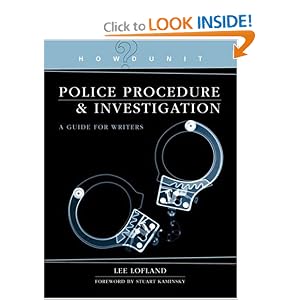
Police Procedure & Investigation: A Guide for Writers (Howdunit)

Ladies and gentlemen, I've found it.

I was hitting a stone wall with my novel, which is a mystery/suspense/crime drama/supernatural horror hybrid. I knew what was causing the impasse, too (very reassuring, btw, being able to diagnose the block!). There's a romantic interest between my main character (crime blogger Maggie McCrae) and the federal agent in charge of the case of her missing sister (the point on which the whole story turns). Trouble was, every time I wrote a scene involving the agent, his partner, and his encounters with the small-town police force, the dialogue fell flat and even I couldn't care less about what happened to the characters. The heart of the matter was that I don't understand police procedures well enough to write a convincing story about a missing-persons case in which a crime blogger hooks up with the detective in charge of her sister's case.

So I was trolling around on the Writer's Digest site, and there was the Holy Grail. Hiding in plain sight. It just arrived today.

Police Procedure & Investigation: A Guide for Writers is the book, by Lee Lofland. I can tell at a glance that it's going to solve most if not all of my problems in writing convincingly on the subject. My main sticking point was the interplay of the FBI and local law enforcement in solving a missing-persons case that originates in a small town but soon becomes a serial case that affects an entire metro area. Thanks to Lee Lofland, I'm no longer stumbling around in the dark.

This isn't going to be a novelized CSI or Without a Trace episode: the story is much more about Maddie's relationship with her lost sister, her bumpy romance with Special Agent Rodriguez, and their fight against the criminal mastermind known as The Scorpion.

If you're writing a thriller, a crime drama, or anything that needs realistic touches regarding law enforcement, this book is a must-have for your reference shelf.

Cheers,

WKF

Thursday, August 4, 2011

Freedom to Write


Image from floatingrobes.blogspot.com
People sometimes have the notion that writing fiction and writing for businesses or organizations occupy entirely different universes. I actually may have intimated as much is my first post when I wrote of the gulf between writing to pay the bills and writing to express one's soul.

In fact, creative writing is creative writing, whether one is working on a novel manuscript or a public relations campaign. When one is drawn to a particular website or convinced to buy a product or service, it is usually because some creative scrivener has been concocting copy that is accessible, genial, amusing, informative, or all of the above. Some of the same qualities a good novelist brings to bear when she creates a story that compels the reader to turn the next page.

Frank Herbert, the late author of the science fiction classic Dune, wrote that "Money for a writer means the freedom to write." Indeed, being free of the obligations of a full-time job is one of the greatest commodities a creative writer could wish for, because it means he is free to devote all his energies to his craft. And for those of us in the craft, the greater purchasing power of a regular paycheck is nothing compared to this freedom.

Cheers,

WKF

An Inherent Contradiction


It's a contradiction inherent in the life of the writer. Most of us are intensely private people, introspective and contemplative by nature. Yet, unless we want to write only for ourselves or our immediate circle, we need to possess--or at least convincingly fake--traits at the other end of the personality spectrum. Sure, there are writers out there who are so well-established that people are lined up 14-deep to do all their publicity, marketing and sales. But the vast majority of us must force ourselves to act against type and be shameless self-promoters; otherwise our writing will remain unknown and unread by the wider world.

Thanks to the 'Net, those of us who are indeed the taciturn type--and for whom hawking our wares is anathema--are saved a great deal of hardship. We can create websites and blogs (like this one) and reach out to potential readers while remaining in the cocoon of our office or study. But writers who hope to make a living doing what they love simply must bite the bullet and devote a great deal more thought and energy to marketing and sales than they may have thought would be required for the professional writer.

Cheers,

WKF

A Freelance Writer's Reference Shelf


I realize that this guarantees me a place in the Nerd Hall of Fame, but I often wonder what reference books other writers have on their desks, and how much of their collection overlaps with my own. For those of you who are interested in such minutia, here are the ones I keep within easy reach:

Writer's Market 2011 (Ed. Brewer)
The Merriam-Webster Dictionary
Roget's Desk Thesaurus
The Writer's Essential Desk Reference (Diemling et al)
The AP Stylebook and Briefing on Media Law (Ed. Christian et al)
The Complete Rhyming Dictionary (Ed. Wood)
Every Writer's Guide to Copyright and Publishing Law (Kozak)
The Oxford Dictionary of Quotations

Cheers,

WKF

Writing About Writing

Image from www.law.georgetown.edu
It's a funny thing, writing about writing. I've often thought that the most entertaining thing for a writer to do would be to concurrently write a book about the process of writing a book while writing another one. When you're inside the process, that's by far the best time to express what it entails. Right?

I got this idea to pitch a book called How to Write a Book about Writing a Book While Writing a Book one day while I was bidding on freelance gigs. I do lots of business writing, SEO articles, blog posts, other Web content, etc. I'm also writing a novel. One of the gigs I bid on was for someone to write an ebook about how to write a book. I thought it would be a riot to write a "how-to" book on writing while immersed in a separate, major writing project.

I didn't win that particular bid, but I'm still thinking of pitching the idea to my editor. There would be lots of humor deriving from the absurdity of the task, and it could probably be fairly entertaining. A chance to get inside a novelist's head while he's creating his masterpiece. Or whatever.

Cheers,

WKF

P.S. On a tangentially related note, I spent approximately an ice age searching for the just-write over art to accompany the ebook version of my work-in-progress, Manifestations. I finally settled on this one because it's so deliciously creepy.

Your Preview Image